
WASHINGTON, D.C. — Americans for Fair Treatment today released a new Oklahoma installment of its “Where Do Your Dues Go?” transparency project, examining how the Oklahoma Education Association—the state’s largest teachers union—spent approximately $7.9 million during fiscal year 2025.
Based on OEA’s publicly available federal tax filings, Oklahoma campaign-finance records and state lobbying-registration data, the report follows the money across staff compensation, employee benefits, conferences, travel, political committees, lobbying and reserves. AFFT also released a one-page Oklahoma Union Dues Snapshot designed to give educators, lawmakers, journalists and taxpayers an accessible overview of the findings.
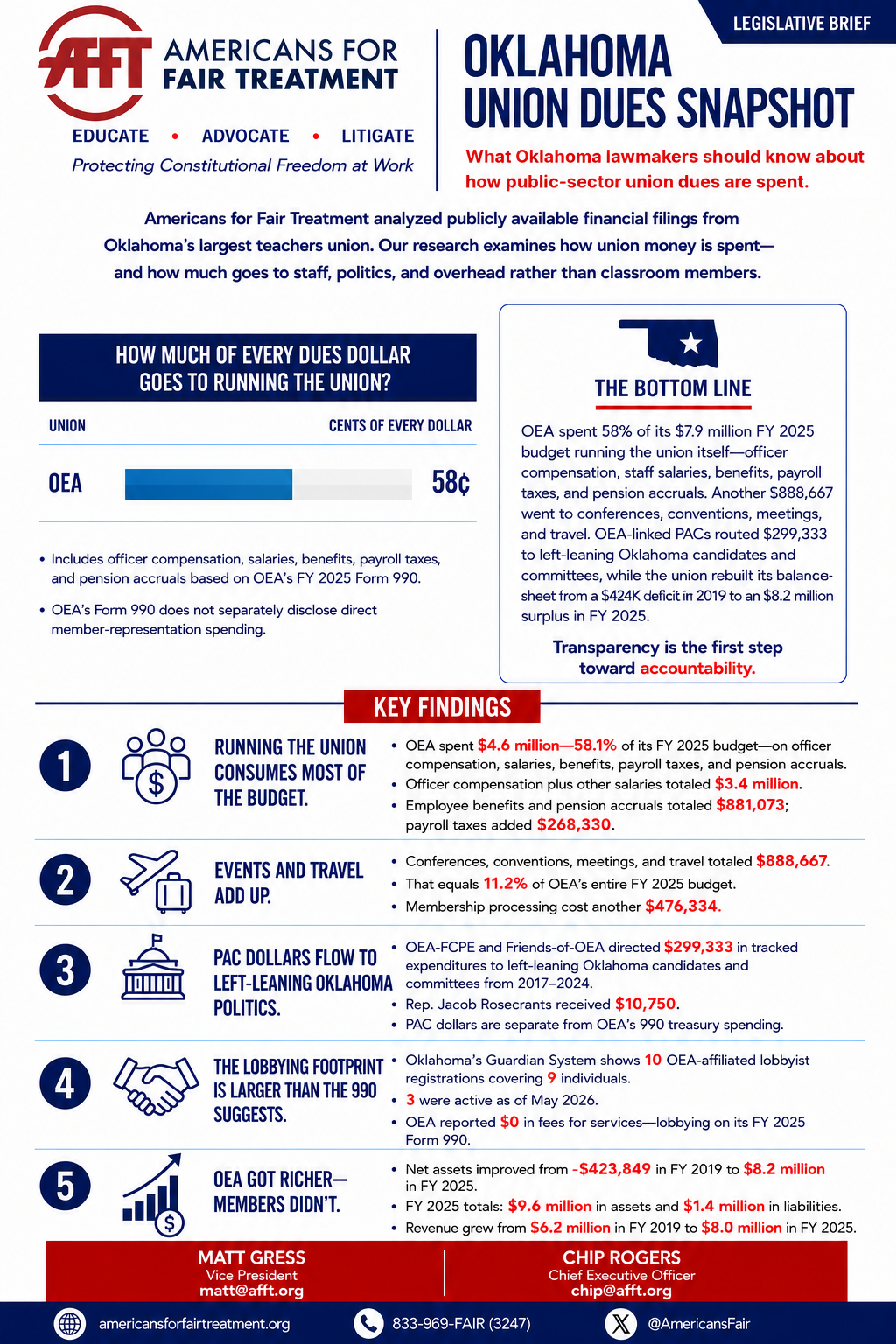
View the Oklahoma Union Dues Snapshot
“Oklahoma educators deserve a clear receipt for the money they are asked to pay,” said Chip Rogers, CEO of Americans for Fair Treatment. “OEA’s own filings show that nearly six of every ten dollars in its budget went to salaries, benefits, payroll taxes and pension costs, while conferences and travel approached $900,000. The people funding an organization deserve more than slogans. They deserve the facts.”
Among the report’s findings:
- Compensation-related costs consumed 58.1% of OEA’s budget. Officer compensation, other salaries and wages, employee benefits, pension accruals and payroll taxes totaled $4,595,199 in FY 2025.
- Conferences and travel added another $888,667. OEA reported $557,404 for conferences, conventions and meetings and $331,263 for travel—together accounting for 11.2% of the union’s total spending.
- The filing does not separately identify direct member-representation spending. As a result, educators reviewing OEA’s Form 990 cannot find a clear line showing precisely how much was spent on bargaining or individual workplace representation.
- Two officials identified with “Past” titles received more compensation than the sitting president. Past Executive Director Carolyn Crowder received $165,261, Past President Katherine Bishop received $151,018 and current President Cari Elledge received $104,440.
- OEA’s broader political and lobbying footprint does not appear in one place. Two OEA-linked political committees directed $299,333 in tracked contributions to Oklahoma candidates and committees between 2017 and 2024. Those PAC dollars are separate from OEA’s Form 990 treasury spending. OEA’s Form 990 also reported $0 in fees for outside lobbying services, while Oklahoma’s Guardian System showed 10 active or historical OEA-affiliated lobbyist registrations covering nine individuals, three of which were active as of May 2026.
- OEA’s net assets grew by more than $8.6 million. The union went from a $423,849 deficit in FY 2019 to $8,191,194 in net assets in FY 2025, ending the year with approximately $9.6 million in assets and $1.4 million in liabilities.
“Transparency is not an attack on workers or unions,” Rogers continued. “It is what makes worker choice meaningful. OEA is free to explain and defend every expenditure in this report, and Oklahoma educators are free to decide whether those expenditures reflect their values and workplace needs.”
Recent AFFT interviews with Oklahoma lawmakers also underscored the need for accessible information about labor policy.
“There perhaps is more education that needs to take place, because workforce issues and labor issues are not something that most people come to the Capitol understanding or have any background in,” said Oklahoma Senate Majority Floor Leader Julie Daniels.
Oklahoma Rep. Mark Lepak emphasized the importance of worker choice.
“We are a right-to-work state. Nobody has to join a union. But it’s hard to change your representation if you want to,” Lepak said.
The Oklahoma release continues AFFT’s nationwide union-transparency initiative, which launched at the state level with a comprehensive examination of five major public-sector unions in Pennsylvania. The project is designed to give public employees, policymakers, journalists and taxpayers a straightforward look at how union-related money is spent.
“Union accountability begins with a simple question: Where did the money go?” Rogers said. “Workers should not have to search through hundreds of pages of tax, campaign-finance and lobbying records to get an answer. AFFT is putting the information in one place so they can make an informed decision for themselves.”
The full Oklahoma report package is available below:
Oklahoma Education Association: Where Do Your Union Dues Go?
Public-sector employees seeking information about union membership, dues deductions and their constitutional rights in the workplace can visit AFFT’s website or call 833-969-FAIR (3247).